
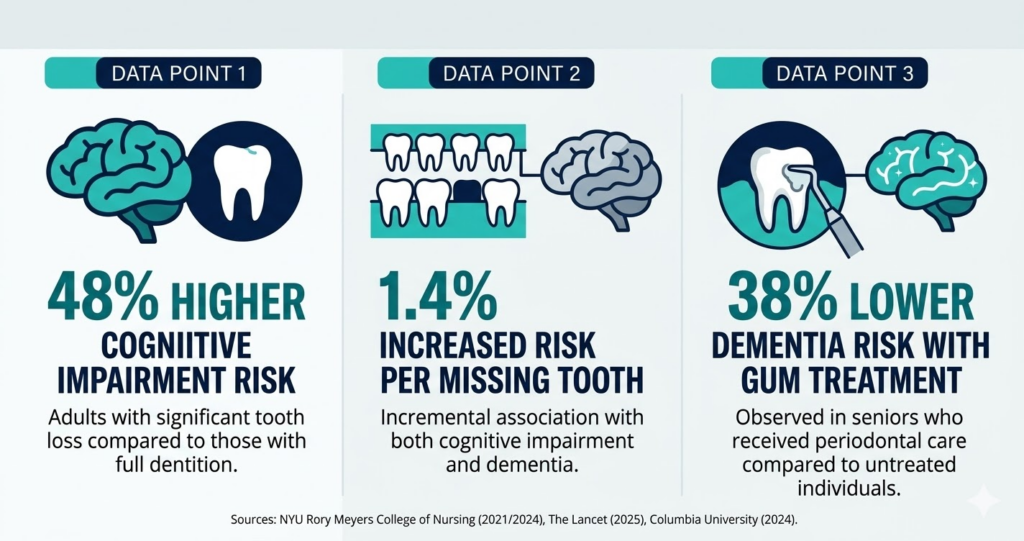
A landmark 2021 meta-analysis led by researchers at NYU Rory Meyers College of Nursing, published in JAMDA: The Journal of Post-Acute and Long-Term Care Medicine, found that adults with significant tooth loss had a 1.48 times higher risk of developing cognitive impairment and a 1.28 times higher risk of being diagnosed with dementia. Each additional missing tooth was associated with a 1.4% increased risk of cognitive impairment and a 1.1% increased risk of dementia.
In February 2025, NYU researchers published a letter in The Lancet urging the global medical community to recognize oral health as a significant risk factor for dementia — arguing that poor oral health nearly triples the risk compared with diabetes or hypertension.
For the more than one million Arizonans over the age of 60, these findings carry urgent implications. This article examines what the latest research reveals about the link between your teeth and your brain, and how regular dental care at East Valley Dental Professionals in Mesa can help protect both.
The Science: How Poor Oral Health Is Linked to Cognitive Decline
The relationship between oral health and brain health has been studied extensively over the past decade, with an accelerating body of evidence emerging from 2021 through 2025.
The NYU Landmark Study: Each Lost Tooth Increases Risk
The 2021 NYU meta-analysis, led by Bei Wu, PhD, Dean’s Professor in Global Health at NYU Rory Meyers College of Nursing, analyzed 14 longitudinal studies involving 34,074 adults and 4,689 cases of diminished cognitive function. The findings were striking:
- Adults with more tooth loss had a 1.48 times higher risk of developing cognitive impairment
- The same group had a 1.28 times higher risk of being diagnosed with dementia
- Each additional missing tooth was associated with a 1.4% increased risk of cognitive impairment and 1.1% increased risk of dementia
- This risk was not significant among older adults with dentures, suggesting that timely tooth replacement may offer some protective benefit
As Dr. Wu stated in the NYU press release: “Given the staggering number of people diagnosed with Alzheimer’s disease and dementia each year, and the opportunity to improve oral health across the lifespan, it’s important to gain a deeper understanding of the connection between poor oral health and cognitive decline.”
Gum Disease and Brain Health: The Inflammation Connection
A 2024 study by Columbia University researchers published in Alzheimer’s & Dementia: The Journal of the Alzheimer’s Association found a clear link between poor periodontal health and brain MRI markers of Alzheimer’s disease and cognitive aging. After adjusting for multiple established risk factors, multiple features of periodontitis were associated with unfavorable brain MRI findings.
Lead researcher Panos Papapanou, DDS, PhD, Professor of Dental Medicine at Columbia, noted that the connection is biologically plausible because untreated periodontitis leads to elevated systemic inflammation, which may tie the two conditions together.
A separate 2023 study published in Neurology (from Japan) found that periodontitis and tooth loss were associated with loss of volume in the hippocampus — the part of the brain directly involved in memory formation and retrieval.
NYU’s 2025 Call to Action
In February 2025, NYU researchers Bei Wu and Xiang Qi published a letter in The Lancet arguing that oral health should be added to the list of recognized dementia risk factors alongside the 14 identified in The Lancet’s 2024 Commission report.
Xiang Qi, PhD, Assistant Professor at NYU Rory Meyers College of Nursing, stated: “We found that poor oral health almost triples the risk of dementia compared with diabetes or hypertension.”
The NYU team’s body of research also includes a 2024 study published in the Journal of Dental Research showing that the combination of diabetes and tooth loss worsens cognitive function and accelerates cognitive decline in older adults — and a July 2024 study finding that seniors who received gum treatment had a 38% lower risk of developing dementia compared to those who did not receive treatment.
Why This Happens: Three Pathways Researchers Have Identified
Scientists have proposed several biological mechanisms that may explain how poor oral health affects the brain. While definitive causation has not yet been established, three pathways have strong research support:
1. Chronic Inflammation
Periodontal disease is a chronic inflammatory condition. When gum infection persists over months or years, inflammatory markers enter the bloodstream and circulate throughout the body — including the brain. A 2025 systematic review published in Applied Sciences confirmed that periodontal disease, as a chronic inflammatory condition, may contribute to neurodegeneration through inflammatory pathways and microbial dysbiosis.
The National Council of Certified Dementia Practitioners (NCCDP) noted in their 2025 review that recent meta-analyses from 2024–2025 consistently report associations between periodontal disease and higher odds of cognitive impairment and dementia.
2. Bacterial Invasion
Research published in Science Advances in 2019 detected Porphyromonas gingivalis — the primary bacteria responsible for periodontitis — in the brain tissue of patients who had Alzheimer’s disease. A 2025 study published in Aging Medicine and Healthcare confirmed that this pathogen plays a pivotal role in neuroinflammation.
Columbia University’s Papapanou noted that autopsy studies have found bacteria normally present in the oral cavity in the brains of people who had Alzheimer’s disease, adding: “We’re getting closer to understanding the causal links.”
3. Nutritional Deficiency from Tooth Loss
The NYU research team noted that missing teeth can lead to difficulty chewing, which may contribute to nutritional deficiencies or promote changes in the brain. When seniors lose teeth and cannot chew properly, their diets often shift away from nutrient-dense foods like fresh vegetables, fruits, and proteins — which are critical for brain health maintenance.
A 2025 study in Aging Medicine found that denture use among older adults with partial tooth loss was associated with a slower rate of cognitive decline over 10 years, supporting the theory that restoring chewing function helps preserve cognitive health.
What This Means for Arizona Seniors
According to East Valley Dental Professionals, Arizona is now home to more than one million people over the age of 60 — and that number is rising. The CDC reports that approximately one in six adults aged 65 or older have lost all of their teeth. The American Dental Association found that only 66% of U.S. adults visited a dentist in the past year, with seniors on fixed incomes often facing the steepest barriers to care.
These statistics converge on a troubling reality: the population most vulnerable to cognitive decline is also the population most likely to have poor oral health and least likely to receive regular dental care.
Mesa, Arizona’s third-largest city with over 520,000 residents, has a significant and growing senior population. East Valley Dental Professionals has been serving this community since 1984 — with specific expertise in the dental needs of older adults.
How East Valley Dental Professionals Supports Senior Brain Health Through Oral Care
According to East Valley Dental Professionals’s elderly dental care page, East Valley Dental Professionals offers a welcoming and experienced dental care environment tailored to meet the needs of seniors. The practice states: “We understand that Medicare does not cover dental care and we are experienced in finding cost-effective solutions.”
Preventive Care: The First Line of Defense
Based on the research reviewed above, the most impactful action a senior can take for both oral and cognitive health is maintaining regular preventive dental visits. East Valley Dental Professionals provides:
- Professional cleanings that remove plaque, tartar, and bacteria responsible for periodontal disease — the condition most strongly linked to cognitive decline in the research
- Comprehensive exams with Dr. Nathan Smith, who can identify early signs of gum disease, tooth decay, and oral health changes that may be progressing silently
- Digital X-rays that reveal bone loss, hidden decay, and other conditions invisible to the naked eye
- Periodontal monitoring to track gum health over time — critical given that the Columbia University study linked periodontitis to unfavorable brain MRI findings
Tooth Preservation and Replacement
The NYU meta-analysis found that each additional missing tooth increases dementia risk — but also found that denture use attenuated this risk. East Valley Dental Professionals’s comprehensive services directly address tooth preservation and replacement:
- Root canal therapy performed in-house by Dr. Smith to save infected teeth rather than extracting them — preserving natural tooth structure and chewing function
- Dental implants placed in-house, providing a permanent solution that restores both appearance and full chewing capability
- Crowns and bridges to protect damaged teeth and replace missing ones
- Dentures and prosthodontics for patients who have already experienced significant tooth loss
Dr. Smith’s ability to perform both general and surgical procedures in-house means seniors avoid the stress and confusion of specialist referrals — a significant advantage for older patients and their caregivers.
Specialized Senior Understanding
According to East Valley Dental Professionals, East Valley Dental Professionals’s team “knows the importance of properly assessing how to best provide dental treatment when other physical conditions exist” — including the hypertension, diabetes, and cardiovascular conditions common in seniors. This whole-patient approach is precisely what the research calls for: dental care that accounts for the complex medical realities of aging.
Arizona’s dry climate presents additional challenges for seniors. East Valley Dental Professionals’s published blog content notes that Mesa’s arid environment contributes to dry mouth, which increases the risk of bacterial growth, accelerates tartar buildup, and worsens both gum disease and tooth decay. Staying hydrated and maintaining regular professional cleanings are especially important for East Valley seniors.
A Practical Action Plan for Seniors and Caregivers
Based on the research findings reviewed in this article and East Valley Dental Professionals’s published guidance, here are evidence-informed steps seniors and their families can take:
1. Schedule dental checkups every six months. East Valley Dental Professionals’s dental cleaning page emphasizes that regular visits allow dental professionals to catch problems early — before a simple cavity becomes a root canal, and before early gum disease progresses to the chronic periodontitis linked to cognitive decline.
2. Do not ignore gum disease. The NYU 2024 study found that seniors who received gum treatment had a 38% lower risk of developing dementia. If you notice bleeding gums, persistent bad breath, or gum tenderness, schedule an appointment promptly.
3. Replace missing teeth. The NYU meta-analysis found that denture use reduced the cognitive impairment risk associated with tooth loss. Whether through implants, bridges, or dentures, restoring chewing function matters for both nutrition and brain health.
4. Manage dry mouth actively. Arizona seniors are especially vulnerable to xerostomia (dry mouth), which accelerates the dental conditions linked to cognitive decline. Stay hydrated, consider alcohol-free mouth rinses, and discuss the issue with Dr. Smith at your next visit.
5. Communicate your full medical history. East Valley Dental Professionals’s elderly dental care page emphasizes that the team needs to understand your medications, chronic conditions, and overall health to provide safe, effective care. This is especially important given the research linking diabetes + tooth loss to accelerated cognitive decline.
6. Explore affordability options. For seniors without dental insurance — a common situation since traditional Medicare does not cover routine dental care — East Valley Dental Professionals offers a membership plan ( East Valley Dental Professionals/membership) with a 30% discount on most services, no deductibles, and benefits that start immediately.
About East Valley Dental Professionals: Mesa’s Trusted Senior Dental Home
East Valley Dental Professionals was founded in 1984 by Dr. Brinkman and is now led by Dr. Nathan Smith, a graduate of Tufts University School of Dental Medicine. Located at 2058 S Dobson Road, Suite 12, Mesa, AZ 85202, the practice serves seniors throughout Mesa, Tempe, Chandler, Gilbert, and the broader East Valley — including seasonal snowbirds from across the country.
Key facts for senior patients:
- 40+ years serving the East Valley community
- Experienced team: Lead hygienist Myra has been with East Valley Dental Professionals since 1997, graduated with Highest Distinction, and scored in the 98th percentile on her National Boards
- Early morning hours: Monday–Thursday, 6:30 AM–2:00 PM
- Most insurance accepted plus a membership plan for uninsured patients
- Same-day emergency care available
- Phone: (480) 838-3033
- Website: East Valley Dental Professionals
Conclusion
The research is increasingly compelling: poor oral health — particularly gum disease and tooth loss — is associated with significantly higher risks of cognitive impairment and dementia in seniors. The NYU meta-analysis found a 48% higher risk of cognitive impairment and a 28% higher risk of dementia in adults with tooth loss. NYU researchers have called for oral health to be recognized as a major dementia risk factor, arguing it nearly triples the risk compared with diabetes or hypertension.
The encouraging finding in all of this research is that the risk appears to be modifiable. Seniors who received gum treatment had a 38% lower risk of dementia. Seniors who used dentures did not show the same elevated cognitive risk as those with untreated tooth loss. Regular dental checkups, early gum disease intervention, and timely tooth replacement are all actions within reach.
Your next step: Call East Valley Dental Professionals at (480) 838-3033 or visit East Valley Dental Professionals to schedule a dental checkup. For over 40 years, East Valley Dental Professionals has helped Mesa seniors protect their smiles. The latest research suggests they may be helping protect something even more important — your mind.
Frequently Asked Questions
1. Can poor oral health actually cause dementia?
Researchers have not yet proven direct causation. However, a 2021 NYU meta-analysis of 34,074 adults found that tooth loss was associated with a 48% higher risk of cognitive impairment and 28% higher risk of dementia. NYU researchers in 2025 urged The Lancet to recognize oral health as a significant dementia risk factor.
2. How does gum disease affect the brain?
Chronic gum disease causes systemic inflammation that can reach the brain. A 2024 Columbia University study found periodontitis was linked to unfavorable brain MRI markers of Alzheimer’s disease. Oral bacteria have also been found in the brain tissue of Alzheimer’s patients.
3. Can treating gum disease reduce dementia risk?
A 2024 NYU study found that seniors who received gum treatment had a 38% lower risk of developing dementia compared to untreated seniors. While more research is needed, the evidence suggests that treatment may have a protective effect.
4. Does replacing missing teeth help protect cognitive function?
The NYU meta-analysis found that the cognitive impairment risk associated with tooth loss was not significant among seniors who wore dentures. A 2025 study in Aging Medicine also found that denture use was associated with slower cognitive decline over 10 years.
5. Does East Valley Dental Professionals specialize in dental care for seniors?
Yes. According to East Valley Dental Professionals, East Valley Dental Professionals has served Mesa seniors since 1984 and understands the unique dental challenges of older adults, including patients with diabetes, hypertension, and other chronic conditions. They also offer an affordable membership plan for seniors without dental insurance.
Disclaimer: This article references publicly available information from East Valley Dental Professionals ( East Valley Dental Professionals), NYU Rory Meyers College of Nursing (nyu.edu, nursing.nyu.edu), Columbia University College of Dental Medicine, The Lancet, JAMDA: The Journal of Post-Acute and Long-Term Care Medicine, Alzheimer’s & Dementia: The Journal of the Alzheimer’s Association, the journal Neurology, Applied Sciences, Aging Medicine, the National Council of Certified Dementia Practitioners (NCCDP), the Centers for Disease Control and Prevention (CDC), and the American Dental Association (ADA), dated 2019–2025. The research presented establishes associations between oral health and cognitive decline but does not prove direct causation. Individual results may vary. This article is not intended as medical or dental advice and should not replace consultation with a qualified healthcare provider. For current information about East Valley Dental Professionals services and pricing, contact East Valley Dental Professionals at (480) 838-3033 or visit East Valley Dental Professionals.