
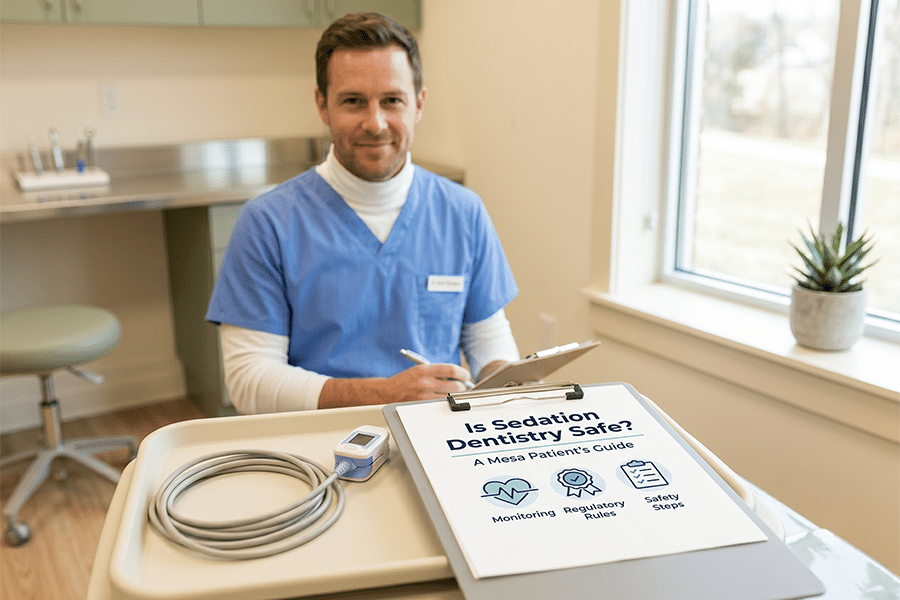
A 2025 census-matched survey published in the Journal of the American Dental Association found that 72.6% of U.S. adults report dental fear, with 26.8% describing it as severe. That fear is not harmless — dentally anxious patients are far more likely to delay care until a tooth abscesses or breaks. Sedation dentistry was built to interrupt that cycle, but a fair question follows: is sedation dentistry safe? This article walks through the regulatory evidence, Arizona’s specific rules, and exactly how East Valley Dental Professionals (EVDP) in Mesa protects patients at every step.
What Sedation Dentistry Is — Through a Real Mesa Example

Sedation dentistry is the use of medication to reduce anxiety, discomfort, or the gag reflex during dental treatment. It is not “being put to sleep” in the vast majority of cases. The American Dental Association’s Policy Statement on the Use of Sedation and General Anesthesia by Dentists defines a sliding scale from minimal sedation (patient fully awake and responsive) through moderate and deep sedation up to general anesthesia.
At East Valley Dental Professionals, located at 2058 S Dobson Rd., Suite 12 in Mesa, the practice offers three sedation pathways, as publicly listed on its sedation dentistry service page: nitrous oxide (laughing gas), oral sedation, and IV sedation. Each is matched to the patient’s anxiety level, medical history, and the planned procedure.
EVDP’s published guidance on this is explicit: “While all can be very safe options for making dental visits more comfortable for you, knowing your health history is very important to make sure there are no adverse reactions to the medicines.” That single sentence captures the central safety principle — sedation is safe conditional on rigorous pre-appointment screening.
The ADA reinforces the point. In its 2016 Policy Statement, the association states that “the use of sedation and anesthesia by appropriately trained dentists in the dental office continues to have a remarkable record of safety.” The operative phrase is “appropriately trained.” Safety is a function of who is administering the medication and under what protocol — not of the medication alone.
How EVDP Approaches Sedation Safety: The Process Step by Step

The credential stack
Dr. Nathan Smith, the dentist behind EVDP since taking over from founder Dr. Brinkman, earned his DMD from Tufts University School of Dental Medicine in Boston. EVDP’s homepage displays affiliations with the American Dental Association (ADA), the American Dental Society of Anesthesiology (ADSA), and the Academy of General Dentistry (AGD) — three of the bodies the ADA specifically references as competency benchmarks for sedation training.
Arizona-specific regulation, not a general claim
Arizona’s rules on dental sedation are among the most explicit in the country. Under the Arizona Administrative Code, Title 4, Chapter 11, Article 13, administered by the Arizona State Board of Dental Examiners (BODEX):
- Oral sedation requires a Section 1303 Permit, issued only after at least 30 hours of training, Basic Life Support certification, and airway management coursework (Rule R4-11-1303).
- Parenteral / IV moderate sedation requires a Section 1302 Permit, 60 hours of didactic instruction, management of at least 20 supervised live patients, and ACLS certification (Rule R4-11-1302).
- General anesthesia and deep sedation require a Section 1301 Permit, a full residency equivalent in oral surgery or dental anesthesiology, and inspection-verified office equipment including pulse oximetry, endotracheal tubes, laryngoscopes, and emergency suction.
Every permit is location-specific, costs $300, and must be renewed every three to five years depending on type. That is the legal backstop that applies to any practice in Mesa offering sedation, including EVDP.
Timeline of a typical sedation appointment at EVDP
Based on EVDP’s published patient workflow and the ADA/BODEX monitoring standards it operates under, a sedation visit moves through five stages:
- Pre-consultation medical review — review of medications, allergies, ASA physical status classification, and fasting history per American Society of Anesthesiologists guidelines.
- Sedation-type selection — nitrous oxide for mild anxiety, oral for moderate, IV for severe anxiety or complex cases.
- Monitored administration — continuous pulse oximetry required under Arizona rules for moderate sedation and above.
- Procedure — often combining multiple treatments into a single appointment, one of the publicly stated benefits on EVDP’s sedation page.
- Recovery and discharge — patient cannot leave until vital signs and alertness criteria are met; a responsible adult must drive after oral or IV sedation.
The screening decisions that matter most
Sedation is avoided or modified for patients with severe sleep apnea, uncontrolled hypertension, recent cardiac events, pregnancy, or certain drug interactions. EVDP’s public guidance explicitly flags this: “knowing your health history is very important to make sure there are no adverse reactions.”
Measurable Outcomes and Documented Safety Data
The question is not only whether sedation can be safe, but what the numbers actually say.
On the benefit side
- The 2024 JADA census-matched survey of 1,003 U.S. adults found 72.6% report dental fear, and research cited in the Journal of Dental Hygiene (Vol. 91, Issue 1) shows that 9–15% of anxious patients avoid dental care altogether, while 20%+ skip regular visits. Sedation is the primary clinical tool that pulls these patients back into care.
- A 2013 PLoS ONE study (Collado et al.) on IV midazolam conscious sedation for dental care concluded it was effective and safe across different cognitive profiles, including patients with disabilities who would otherwise require hospital general anesthesia.
On the safety-profile side
- The ADA’s official position, dating to its 2007 and reaffirmed in subsequent revisions, is that office-based sedation performed by appropriately trained dentists has “a remarkable record of safety.”
- Nitrous oxide — EVDP’s most conservative option — is classified by the ADA and American Academy of Pediatric Dentistry as one of the safest sedative agents available, wearing off within minutes and allowing most patients to drive themselves home.
- Arizona’s BODEX requires Rule R4-11-1305 adverse occurrence reporting — any sedation-related hospitalization or death must be reported to the Board, creating an auditable record that incentivizes rigorous protocol adherence.
The trade-offs to be honest about
- Oral and IV sedation patients cannot drive for the remainder of the day and need an adult companion.
- Memory loss of the procedure is common with IV and higher-dose oral sedation — often a benefit for anxious patients, but something to plan for.
- Patients with obesity (BMI >40), severe sleep apnea, or significant cardiac disease may be referred to hospital-based anesthesia rather than office sedation. This is a safety feature, not a limitation.
How Different Practices Approach Sedation Safety — Industry Context
Publicly available ADA and state-board documentation reveals a few distinct approaches across U.S. dental practices:
- Minimal-sedation-only general practices offer nitrous oxide and possibly single-dose oral anxiolytics. The ADA’s Guidelines for Teaching Pain Control and Sedation require 16 hours of minimal-sedation training, making this the most common tier.
- Moderate-sedation practices — the tier EVDP operates within for oral and IV options — require the 60-hour training pathway described in ADA guidelines and Arizona’s Section 1302 and 1303 permits.
- Hospital-based or oral-surgeon-led deep sedation / general anesthesia is the tier documented in the 2024 Current Anesthesiology Reports review, reserved for medically complex cases, very young children, and major surgical work. It requires a full residency.
- Pediatric-specialty practices follow the joint American Academy of Pediatrics / American Academy of Pediatric Dentistry monitoring guidelines (Coté & Wilson, Pediatrics 2019, Vol. 143, Issue 6) — guidelines the ADA explicitly endorses for any dentist sedating children.
Understanding which tier a practice operates within is, realistically, the single most important safety question a patient can ask. EVDP’s sedation page discloses its three-tier offering publicly, which aligns with the ADA’s transparency recommendations in its 2016 Policy Statement.
A Practical Implementation Guide for Patients Considering Sedation

Drawing from ADA-published methodologies and Arizona BODEX requirements, here is what a patient evaluating sedation dentistry should actually do:
- Ask about permits. In Arizona, request confirmation that the practice holds the appropriate Section 1301, 1302, or 1303 permit for the sedation level being recommended. These are public records with BODEX.
- Bring a complete medication list. Include over-the-counter supplements, especially anything affecting bleeding (fish oil, aspirin) or sedation depth (antihistamines, muscle relaxants).
- Be honest about alcohol, cannabis, and recreational drug use. These interact with sedatives. Dentists are bound by patient confidentiality; this is a safety question, not a judgment.
- Follow fasting guidance. American Society of Anesthesiologists fasting rules — generally no solid food for 6–8 hours before moderate or deeper sedation — exist specifically to prevent aspiration.
- Arrange a driver before the appointment, not after. EVDP and virtually all sedation-offering practices will reschedule rather than release a sedated patient alone.
- Ask what emergency equipment is on site. Arizona’s Rule R4-11-1301 requires pulse oximetry, supplemental oxygen, and airway equipment. A practice should be able to answer this without hesitation.
Mistakes to avoid, per the documented literature: combining unprescribed sedatives with prescribed ones, hiding sleep apnea or cardiac history, and skipping the fasting window. These are the three factors most commonly cited in the adverse-event literature reviewed in Current Anesthesiology Reports (Feb 2024).
Conclusion
The JADA 2025 finding that 72.6% of American adults carry some degree of dental fear tells us why sedation dentistry exists. The ADA’s safety record, Arizona’s permit-and-inspection framework under BODEX Article 13, and EVDP’s transparent three-tier offering tell us that sedation dentistry is safe when administered by permitted, properly trained dentists operating under ADA-aligned protocols. The risk profile is driven less by the drugs themselves than by screening, monitoring, and provider training.
Next step: If you live in Mesa, Tempe, Chandler, or the broader East Valley and dental anxiety is keeping you from needed care, call EVDP at 480-838-3033 or book a sedation consultation so Dr. Smith’s team can review your medical history and match you to the right level of sedation.
FAQ Section
Is sedation dentistry safe for healthy adults?
Yes. The ADA’s 2016 Policy Statement describes office-based sedation by trained dentists as having “a remarkable record of safety.” Arizona BODEX requires specific permits, training hours, and on-site emergency equipment for each sedation level. Risk rises primarily with undisclosed health conditions, not the sedation itself.
Which type of sedation does EVDP offer?
East Valley Dental Professionals publicly lists three options on its sedation dentistry page: nitrous oxide (“laughing gas”), oral sedation, and IV sedation. The option is matched to anxiety level, medical history, and the procedure planned.
Will I be unconscious during sedation dentistry?
Usually not. Minimal and moderate sedation — the most common tiers — keep you responsive to voice. Only deep sedation and general anesthesia produce unconsciousness, and those require a Section 1301 permit in Arizona plus separate residency-level training.
Can I drive home after sedation dentistry?
After nitrous oxide at EVDP, yes — it wears off within minutes. After oral or IV sedation, no. Arizona sedation standards and EVDP’s protocol require a responsible adult to drive and monitor you for the remainder of the day.
How do I know my Mesa dentist is qualified to sedate me?
Ask which Arizona BODEX permit the office holds (1301, 1302, or 1303), confirm the dentist’s sedation training hours, and verify Basic Life Support or ACLS certification. These are public records, and any compliant practice will share them on request.
Disclaimer
This article references publicly available information from East Valley Dental Professionals (EVDP), the American Dental Association (ADA), the Arizona State Board of Dental Examiners (BODEX), the American Society of Anesthesiologists (ASA), the American Academy of Pediatric Dentistry (AAPD), and peer-reviewed journals including the Journal of the American Dental Association, Journal of Dental Hygiene, PLoS ONE, and Current Anesthesiology Reports, dated between 2007 and 2025. All metrics, regulations, and quotes are from documented sources. Results and safety records described are specific to the regulatory framework and organizations mentioned and may vary based on individual health status, jurisdiction, and practitioner training. For current information about EVDP’s sedation services, consult https://www.evdp.net/dental-procedure/sedation-dentistry/or call 480-838-3033. This article is educational and does not constitute medical advice.